
Program
69. DOK Leipzig
FLÜGELSCHLAG
HERALDS OF THE MONSOON – International Animation Competition
The elephant is dead! But who or what is responsible for its death? Blending an ecological whodunit with a light-footed documentary style, Meera Krishnamurthy’s animated film brings two different perspectives into dialogue: the wise voice of the Matti tree, which, like the indigenous Soliga community, has developed its own traditions and rituals for engaging with nature. And then there is a scientific, discursive voice that delivers insights in the form of a butterfly. When presenting their theories about the circumstances of the crime, they each bring their own approach: the Matti tree sings its wisdom, visualised through drawings and time-lapse; the butterfly, on the other hand, prefers to present the latest scientific findings in a laboratory stop-motion sequence. Slowly, the two draw closer to one another – because only by working together can they bring the killer to justice. (Marie Ketzscher)
India 2025 by Meera Krishnamurthy, 9 min, animated film
ERRABONDA
Dear earth, beloved earth! This cinematic love letter is addressed to the earth – and, in a very sensual and tangible way, to the fields of the Arvaia cooperative near Bologna. Here, people sow, harvest, water and caress the land, with devotion and without heavy industrial machinery. The people are only fleeting presences: Emma Harris focuses the visual lens entirely on the flora, from the topsoil to the bud, from sweeping views of the horizon to the intricate branching of leaves, which at times overlap and become abstract patterns in which it is a delight to lose oneself. Her loving, attentive gaze is also captured in words: the love letter, recited by two voices, is not only an expression of profound gratitude to the earth but also conveys the hope that, in the future, humans will work with nature rather than against it. In keeping with these ethical and agroecological reflections, “Errabonda” was made using low-pollution analogue processes. (Marie Ketzscher)
Italy, Denmark 2026 by Emma Harris, 20 min, documentary film
MAROS FOTO – German Documentary Competition
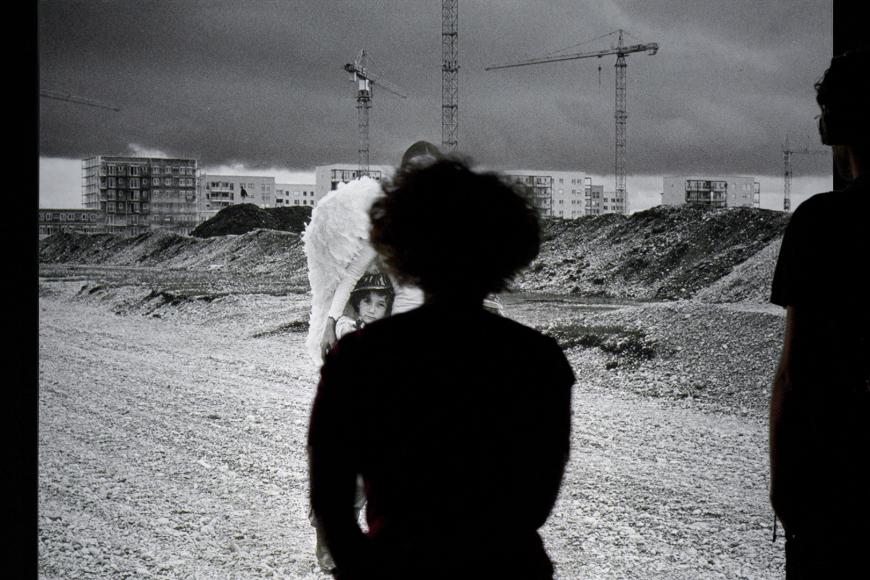
In the early 2000s, Maria Nikolaidou takes a photograph on Munich’s “Panzerwiese”: her son Alexandros and another little boy are playing at war. A woman with angel wings wraps her arms protectively around the two. Twenty-three years later, mother and son return to the place where the black-and-white photograph was taken. Using the same camera, Alexandros now makes a photo film about the image from back then and also meets up with his former playmate. Their memories and associations, heard in voice-over, reveal different perspectives and moods. The history and stories behind a photograph are reconstructed: What was overlooked at the time? Why was Alexandros not allowed to have a weapon from his grandparents? Who is the person on the hill in the background? In the end, a new image emerges. (Anke Leweke)
Germany 2026 by Alexandros Murböck, 30 min, documentary film
ORTSTEIL AUTOBAHN – German Documentary Competition, Focus East
A cinematic observation of a landscape shaped by borders that continue to define it to this day. Even 35 years after reunification, borders remain present in Marienborn. There is the memorial site commemorating the violence of the SED regime. And just a stone’s throw away, there are new borders. Today, refugees live in communal accommodation in the former NVA barracks. They, too, crossed borders to get here, often clandestinely and at the risk of their lives. Now another border separates them from the outside world: a combination of wall and fence that inevitably recalls the former GDR border fortifications. Through long tracking shots, whose wide-angle perspective at times lends the images an almost otherworldly quality, the film observes the coexistence of openness and separation. While the images reveal continuities, the soundtrack brings out the subtle differences between the individual locations. (Luc-Carolin Ziemann)
Germany 2026 by Richard Rothfeld and Luci Schwingen, 10 min, documentary film
TERMINAL – International Animation Competition
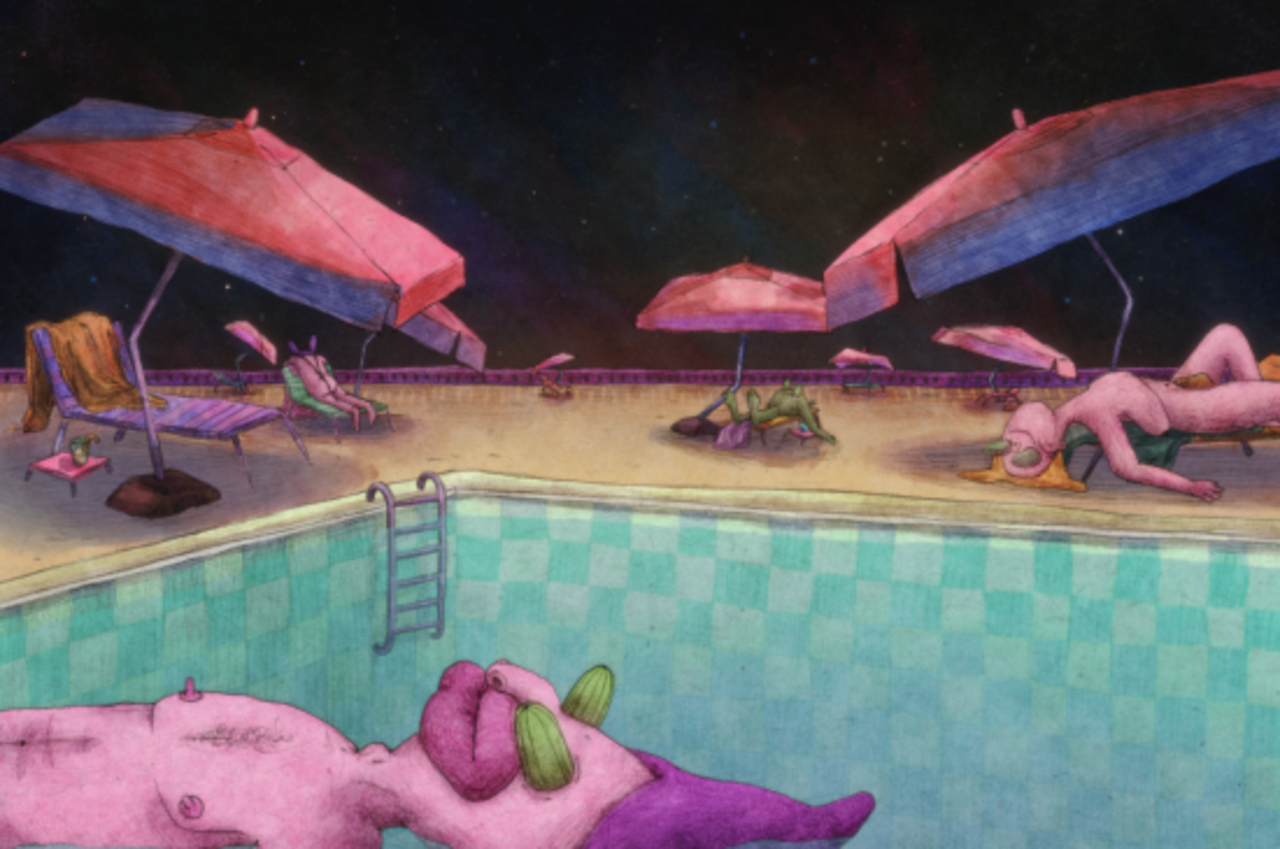
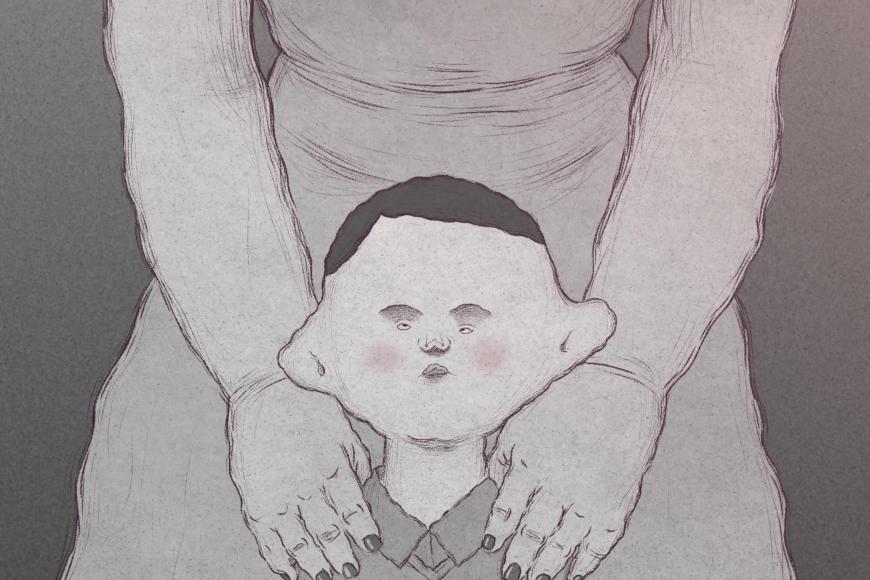
After years at sea, the pirate returns home to his mother. She still loves him unconditionally, just as she did on the day he was born. And that despite all the things that might unsettle her – after all, he has not been in touch for years, now wears a nose ring and is covered in tattoos. And he has secrets to hide, too, as he carries a heavy suitcase home, coughing up blood. With a soft pastel colour palette and distinctly animated characters, Alexandre Siqueira tells the story of what it means for a mother to be forced to watch her own grown child die. But Siqueira is also concerned with the bond between mothers and children more generally, a bond that is sometimes put to the test: the unconventional pirate tattoos can also symbolise other life choices that a mother may initially find alien. Sometimes acceptance also means letting go. (Marie Ketzscher)
Portugal, France, Spain 2026 by Alexandre Siqueira, 17 min, animated film