
Program
69. DOK Leipzig
OUTTA SPACE
BLACK RAIN
Using still and moving images from STEREO, NASA’s satellite mission to observe the Sun, “Black Rain” transforms scientific data into a raw, glitch-ridden view of interplanetary space. The film celebrates the artefact as a stylistic device, offering us an unpolished and almost voyeuristic view of the cosmos, far removed from the glamour of science fiction or the carefully colourised images NASA usually releases to the press. Against a monochrome backdrop of stars and the Milky Way, we follow solar winds, coronal mass ejections and passing comets, sometimes visible only as blurred lines or pixels. (Ben Sassen)
UK 2009 by Semiconductor, 4 min, experimental film
COSMONAUTS
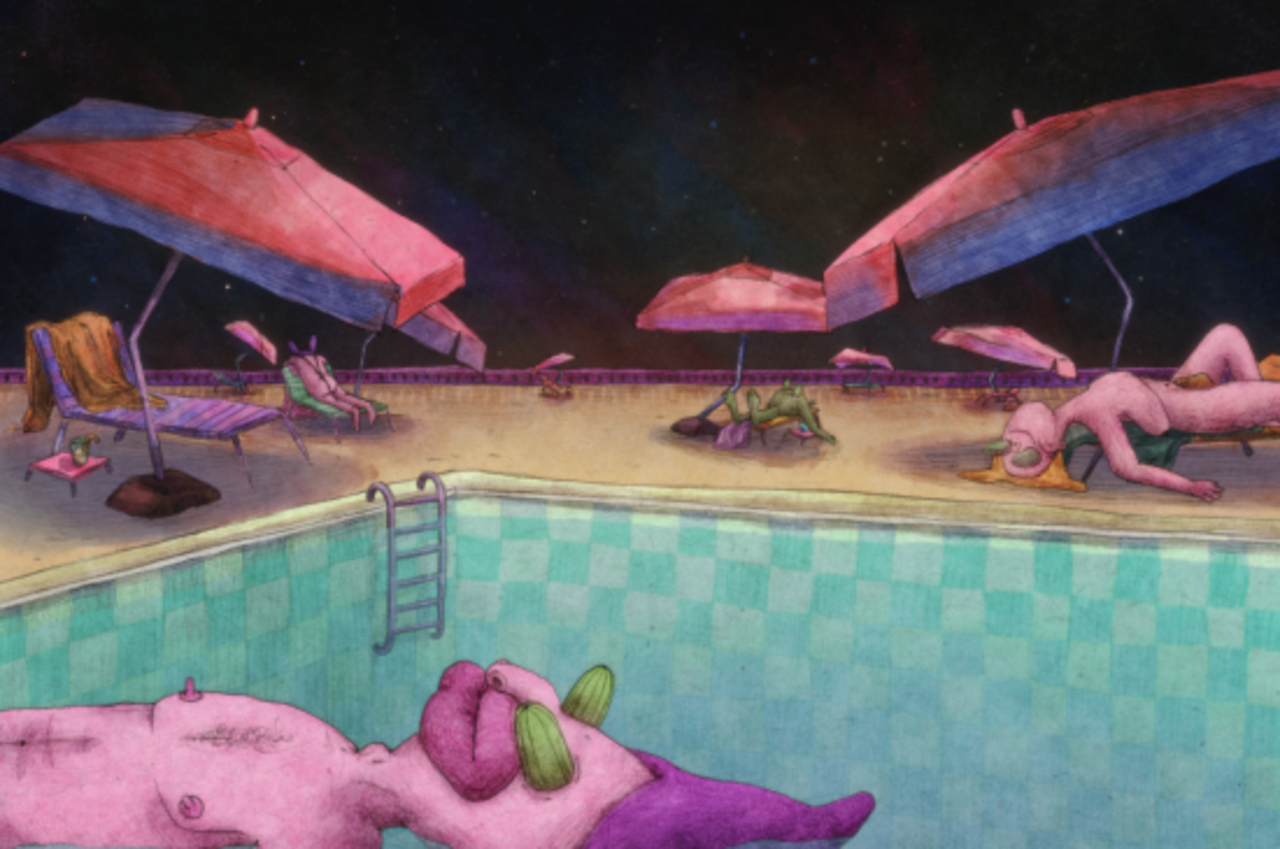
Aboard the Pompelmo Express, a giant pink rocket, everyone longing for tenderness is welcome. Together with a diverse group of passengers shimmering in every colour of the rainbow, Delfino, Rita and Zenf travel through the cosmos of possibilities. While the party rages aboard the spaceship, Zenf spots a fiery comet through his enormous telescope. At an atmospheric tea party, Delfino falls head over heels for Carlos, while Rita struggles with her own body. The infinite expanses and warm darkness of space embrace the travellers in a friendly manner, offering room to explore a wide range of needs. “Say goodbye to your lonely days.” (Franka Sachse)
Slovenia, Italy 2026 by Leo Černic, 15 min, animated film
GALAXIES
Lillian Schwartz, a pioneer of multimedia art and computer animation, created “Galaxies” in the early phase of her 33-year tenure as artist-in-residence at the renowned North American research institution Bell Labs. The work draws on model simulations of galaxies produced at NASA’s Langley Research Center using a powerful mainframe computer, which were made available to Schwartz so she could create a complete film. With a background in Japanese calligraphy and painting, Schwartz often combined art and technology in her work. She approached the material creatively, layering, distorting and colourising the images to breathe new life into the scientific data – with astonishing visual effects. (Ben Sassen)
USA 1974 by Lillian F. Schwartz, 4 min, experimental film
GREEN PLANET
The RK12 galaxy lies 28 quadrillion kilometres from Earth. There, a sandy desert planet is inhabited by an alien species. Without sunlight, the creatures live on the energy of movement itself. They produce time, love music and cast their mortal gods back into space when they have had enough of them. This fictional report showcases the considerable talent of Piotr Kamler. Alongside a feature-length science-fiction film, the Polish avant-garde filmmaker created numerous original and technically outstanding short films. “Green Planet” is a masterful stop-motion animation in which Kamler brings delicate forms made from fine sand to life. Accentuated lighting, contrasts and focus create a fantastical world with impressive spatial depth. The music by Ivo Malec, a pioneer of electroacoustic and contemporary music, heightens the otherworldly atmosphere of this distant setting. (Franka Sachse)
France 1966 by Piotr Kamler, 9 min, animated film
MOONFLIGHT
A Slavic legend, whose central idea also appears in Tibetan records, inspired the Soviet scientists Mikhail Vasin and Alexander Shcherbakov to formulate the “Hollow Moon” hypothesis in 1970. In this hypnotic film, Hungarian director, autodidact and graphic designer Sándor Reisenbüchler explores the theory in a highly poetic manner, transporting us across centuries from an imagined past into a distant future. His distinctive collages, which he painstakingly animated alone at the animation stand with meticulous precision, combined with experimental moving-image footage, evoke memories of analogue projections and the liquid light shows of the 1960s. Organic forms and colourful patterns create a mesmerising pull, carrying us through a magical portal into a hypothetical spaceship inside the Moon. (Franka Sachse)
Hungary 1975 by Sándor Reisenbüchler, 13 min, animated film
SWARM
In November 2013, the European Space Agency (ESA) launched three identical satellites into Earth’s orbit as part of the SWARM mission to study our home planet’s magnetic field in greater detail. Translating the measurement data into sound made fluctuations in the Earth’s magnetic field audible. Kamil Czapiga, whose interdisciplinary art project “Cosmodernism”, launched in 2019, explores the question of a deeply personal form of abstraction in the microcosm and macrocosm, combines these sounds with fascinating material from his moving-image universe. Although they seem alien and unreal, his compositions are made from entirely earthly ingredients, such as oils, coloured water and magnetic fluids, which are stimulated to undergo chemical reactions in microscopic film sets. Homemade mechanisms and special lighting transform the resulting footage into a visual experience that seems out of this world. (Franka Sachse)
Poland 2023 by Kamil Czapiga / Cosmodernism, 11 min, experimental film
WHITE HOLE
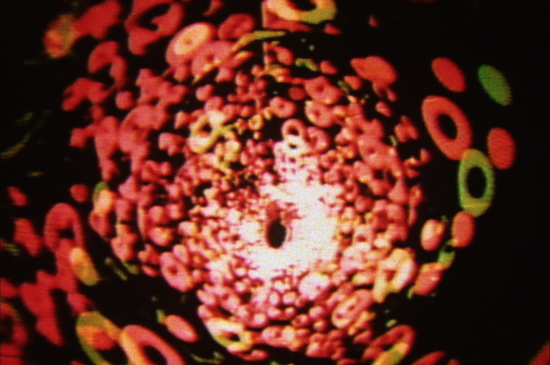
A black hole is defined as a region of space in which objects are trapped and prevented from escaping; a white hole, by contrast, is a hypothetical region of spacetime that cannot be entered from the outside, but from which things can emerge and be released. This is the setting for this visually opulent, hypnotically abstract journey into the expanding void of the universe. “White Hole” appeared towards the end of a period of extraordinarily creative experimentation by director Toshio Matsumoto, one of Japan’s most renowned masters of experimental film and video. Unlike his earlier works on celluloid, he uses video synthesizers and intensive image processing to create a stunning cinematic experience reminiscent of Stanley Kubrick’s “Star Gate” sequence in “2001: A Space Odyssey”, with similar psychedelic undertones and a potentially consciousness-expanding exploration of space. (Ben Sassen)
Japan 1979 by Toshio Matsumoto, 7 min, experimental film
WORLD
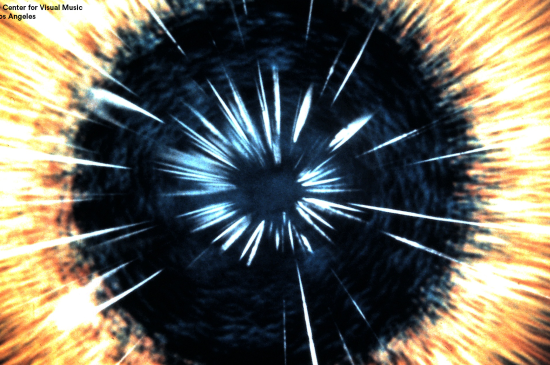
In a fluid sequence, the birth of a world is depicted as a bio-astronomical event. Nebulous, swirling spheres of gas condense into molten membranes and then into a flashing planet. The descent into its erupting electronic forces, towards the core, causes the spark of life to double and multiply. It rises towards consciousness, towards crystalline symmetries. The perception of the whole becomes increasingly condensed. It marks the beginning of an overconsciousness. This film was restored with support from the National Film Preservation Foundation. (Pyramid Films)
USA 1970 by Jordan Belson, 6 min, experimental film
Followed by a performance by Alberto Couceiro (AR) and Kay Kalytta (GER)